Explore the Future of Data Center Design
Discover how tensordc simplifies thermal and flow simulation for data centers, making it accessible for everyone, regardless of CFD expertise. Enhance your HVAC and thermal management systems effortlessly.
5/8/20243 min read


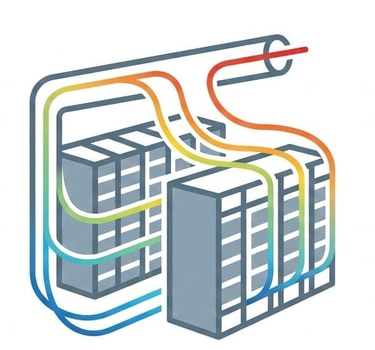
The CFD simulation of a data center plays a vital role in ensuring efficient cooling, reliable equipment performance, and energy savings. As modern data centers continue to increase in computing density, managing airflow and temperature becomes more complex. Inefficient cooling not only wastes energy but can also lead to hardware overheating and system failures. Computational Fluid Dynamics (CFD) provides engineers with a powerful tool to visualize and optimize the thermal and airflow patterns within data centers—long before physical construction or equipment installation takes place.
At its core, CFD simulation uses numerical methods to solve the governing equations of fluid flow and heat transfer. In data center applications, it predicts how cold air supplied by cooling units (such as CRAC or CRAH systems) circulates through server racks, absorbs heat, and returns for re-cooling. By analyzing parameters such as air velocity, temperature distribution, and pressure gradients, CFD enables designers to identify inefficiencies and hotspots that are otherwise difficult to detect. The insights gained help optimize rack layouts, aisle containment strategies, and cooling unit placement to maintain uniform temperature distribution and minimize energy consumption.
The CFD workflow for data center simulation typically begins with creating a 3D model of the facility, including server racks, perforated tiles, raised floors, cable trays, and cooling units. Each component is assigned realistic boundary conditions, such as heat loads for racks and airflow rates for cooling units. The solver then calculates airflow and temperature fields, providing detailed visualizations of how cold and hot air move throughout the space. Engineers use this data to assess critical parameters such as the return temperature index (RTI), supply heat index (SHI), and rack inlet temperature compliance with standards like ASHRAE TC 9.9.
One of the most significant challenges in data center cooling is avoiding the mixing of hot and cold air streams. Without proper containment, cooled air can bypass equipment in some areas while hotspots form elsewhere. CFD helps test various air management strategies, including hot-aisle and cold-aisle containment, raised floor configurations, and underfloor airflow balancing. By simulating these configurations, designers can determine which approach achieves optimal thermal performance while reducing fan energy use. In large-scale facilities, CFD can also evaluate the impact of server load variations, partial equipment failures, or maintenance shutdowns on cooling performance.
CFD simulations also allow for predictive maintenance and what-if analysis. Engineers can model future expansion scenarios to test whether existing cooling infrastructure can handle additional server racks or increased loads. They can also simulate failure conditions—such as a CRAC unit shutdown or a power outage—to evaluate how long the system can maintain safe temperatures. This predictive capability supports risk mitigation and helps ensure data center resilience under various operating conditions.
For facilities pursuing energy efficiency and sustainability goals, CFD provides valuable insights into optimizing Power Usage Effectiveness (PUE). By identifying airflow inefficiencies, bypass leakage, and overcooling zones, CFD enables better control of cooling unit settings and airflow paths. In conjunction with real-time monitoring systems, CFD models can form the basis of digital twins—virtual replicas of data centers that update dynamically based on live sensor data. These digital twins allow continuous performance tuning, enabling operators to respond quickly to temperature fluctuations or airflow imbalances.
From a design perspective, CFD simulations are invaluable during the planning and commissioning phases of a data center. Architects and engineers can test multiple configurations of rack layouts, containment systems, and ceiling plenum designs before construction. The results inform design decisions that maximize airflow efficiency, reduce fan power requirements, and ensure thermal compliance. For retrofitting existing facilities, CFD helps identify specific problem areas—such as underperforming racks or airflow blockages—allowing targeted modifications without costly trial and error.
Advancements in computational power and software have made CFD more accessible for data center designers and operators. Modern CFD tools can handle large-scale, high-resolution simulations and provide intuitive visualizations of airflow and temperature fields. Transient simulations can capture dynamic changes in load or cooling system behavior, providing a more realistic representation of operating conditions. Additionally, automation and optimization algorithms can run multiple design variations, identifying the best configuration based on performance metrics.
In summary, CFD simulation has become an essential component of modern data center design and operation. It bridges the gap between physical cooling infrastructure and digital performance analysis, allowing engineers to visualize airflow, predict temperature distribution, and optimize energy use. By providing a deep understanding of complex airflow interactions, CFD helps ensure thermal reliability, reduce operational costs, and improve sustainability. As computing demands continue to rise, CFD-driven optimization will remain key to designing next-generation data centers that are not only powerful but also efficient, resilient, and environmentally responsible.